Shaping Light with Precision: The Evolution of Framing Projector Technology

Jul. 21, 2026


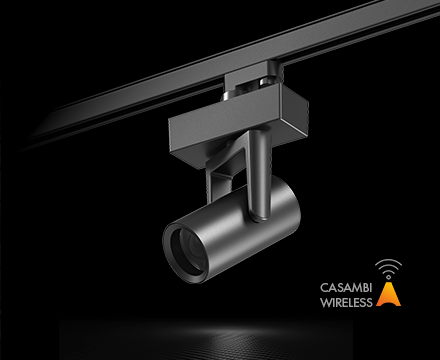
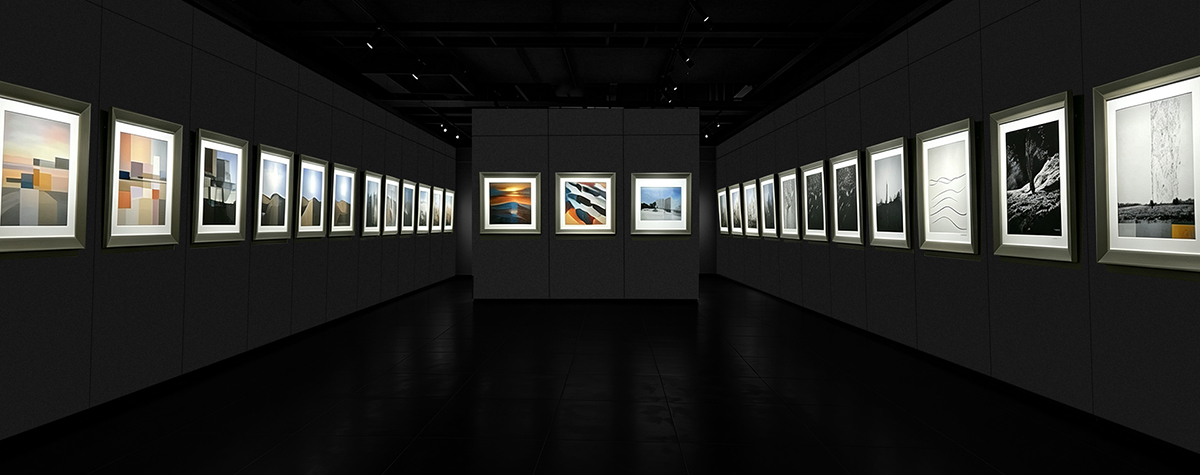
      Walk into any well-lit museum gallery and you will notice something. The light knows where to stop. A painting on the wall glows evenly, edge to edge, while the surrounding wall stays dark. A sculpture in a case is lit from above with no spill onto the glass. A piece of jewelry in a display vitrine catches light so precisely that the diamond seems to float. 
      This does not happen by accident. It takes a framing projector.

      Why light needs edges


      In museums, galleries, luxury retail, and high-end residential spaces, standard accent lighting falls short. The center of the beam runs hotter than the edges, washing out colors in the middle of a canvas. Spill light bleeds past the object you are trying to highlight. Glare from the fixture catches the viewer's eye instead of the artwork. 
      For lighting designers, the problem is not generating light. It is controlling where light goes and, just as important, where it does not. Framing projectors solve this by shaping light into clean geometric patterns with hard edges that define exactly what gets illuminated and what stays dark. 
      At Encore, we have spent the last decade building and refining these tools. The journey taught us that precision lighting is less about brightness and more about discipline.


Shaping Light with Precision: The Evolution of Framing Projector Technology


      From TLM to VEGA: ten years of chasing sharpness


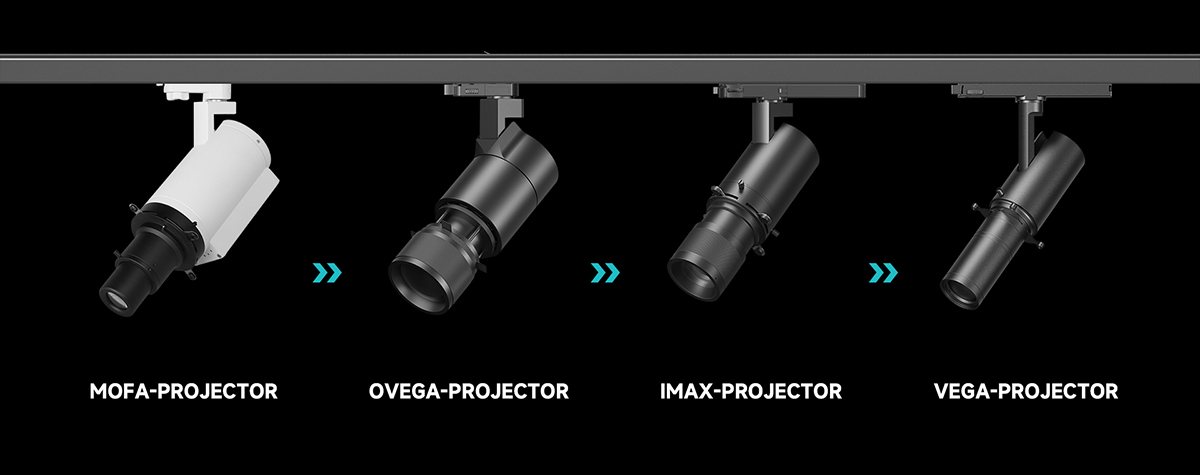
      Encore released its first framing projector, the TLM, in 2015. Over the next ten years, the product line went through four generations: TLM, then OVEGA, then IMAX, and now VEGA. Each generation solved one specific problem the previous one could not. 

      The problems were not theoretical. They came from installers in the field, from museum curators complaining about color shifting across a beam, from retail designers who needed tighter beam control for window displays. Every iteration started with a real-world failure and ended with an engineering fix.

Shaping Light with Precision: The Evolution of Framing Projector Technology


      Framing precision: from imperfect edges to true symmetry


      For a framing projector, the core requirement is simple to state and hard to achieve: project a clean, geometrically precise rectangle of light with no distortion, no color fringing, and no artifacts inside the cut shape. In practice, this proved to be the most persistent engineering challenge across all four generations. 
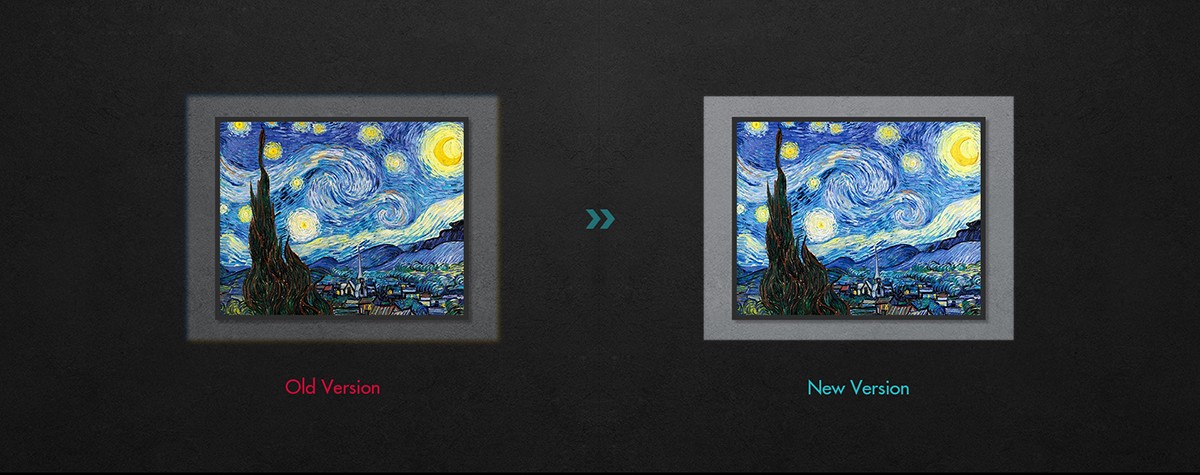
      In our early TLM units, the cut beam often had two or three sharp edges and one or two soft ones. The soft edges showed inward bowing, distortion, or color fringing at the boundary. A common symptom was a blue-yellow separation that appeared along one or two edges while the others looked clean. When you are lighting a rectangular painting, a soft edge on one side means light bleeding onto the wall frame, which breaks the whole visual effect. We traced the root causes to three things.

      Lens surface figure and light transmission. Microscopic inconsistencies in lens curvature caused light ray distortion inside the cut beam. Instead of a clean, even rectangle of light, you would see bright spots, dark patches, or faint stripes across the illuminated area. The lens was shaping the beam, but not uniformly. Poor light transmission through the optical path made the artifacts worse. 

      Blade material stability under sustained heat. The framing blades sit close to the LED source, where temperatures run high during continuous operation. Standard blade materials oxidized and warped over thousands of hours of use. A blade that started flat would bow inward, and the cut edge would soften or distort. The effect was gradual. A fixture that looked perfect at installation would drift over time, and nobody would notice until the lighting looked wrong. 

      Blade manufacturing precision. Conventional stamping produced micro-burrs, dimensional variations, and edge inconsistencies. When multiple blades overlap to form the cut shape, any gap between them, and we are talking microns, allows stray light to leak through. That stray light creates edge ghosting and reduces contrast at the boundary. Each of these problems is small in isolation. Together, they prevent the one thing a framing projector needs to do: deliver a clean, sharp, symmetrical cut.

Shaping Light with Precision: The Evolution of Framing Projector Technology


      The engineering fix


      The current generation addresses all three issues through targeted engineering changes.
      Shaping Light with Precision: The Evolution of Framing Projector Technology

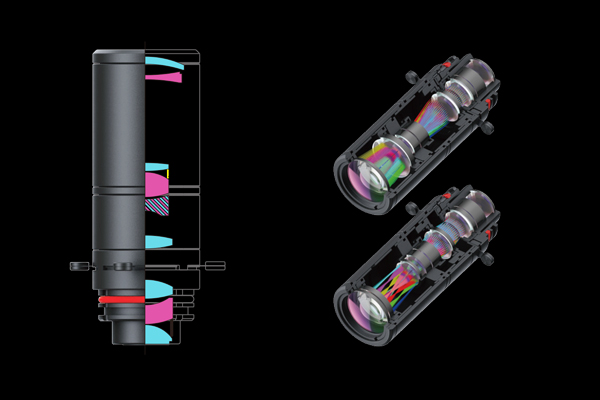
      Precision lens group with AR coating. We improved the surface figure accuracy of the lens group and applied anti-reflective (AR) coatings tuned to the LED spectrum. This raised light transmission through the optical path and eliminated the internal beam artifacts that plagued earlier models. No more bright spots, dark patches, or faint stripes inside the cut shape. Tighter mechanical alignment between the lens axis and the framing blade plane means the focal plane hits all four blades at the same distance, eliminating edge aberration and the blue-yellow color fringing that appeared along beam boundaries in earlier generations. 


      High-stability stainless steel blades. The blade material was upgraded to a high-stability, corrosion-resistant, heat-tolerant stainless steel. This eliminates the oxidation and thermal warping that degraded cut quality over thousands of hours of continuous operation. The cut shape stays consistent for the life of the fixture, with no measurable drift in edge sharpness. 


      Chemical etching replaces stamping. Stamping applies mechanical stress to sheet metal, producing micro-burrs, dimensional variations, and edge inconsistencies. Chemical etching removes material without applying stress, producing blade edges that are clean, uniform, and dimensionally consistent. The result is better light distribution consistency from fixture to fixture, and reliable batch-to-batch stability in production.


      The system can now deliver uniform sharpness across all four edges, what we call symmetric optical cutting. All four edges equally crisp, equally clean, and they stay that way over the life of the fixture.
      Where the technology stands now


      The engineering work above translates into concrete improvements that matter on site.

      Beam quality. Light inside the cut shape is even from center to edge. Color temperature shift across the beam, which could run several hundred kelvin in earlier models, is now negligible at any color setting. For museum-grade lighting where a curator needs to verify that a painting’s colors appear exactly as intended, this matters. 

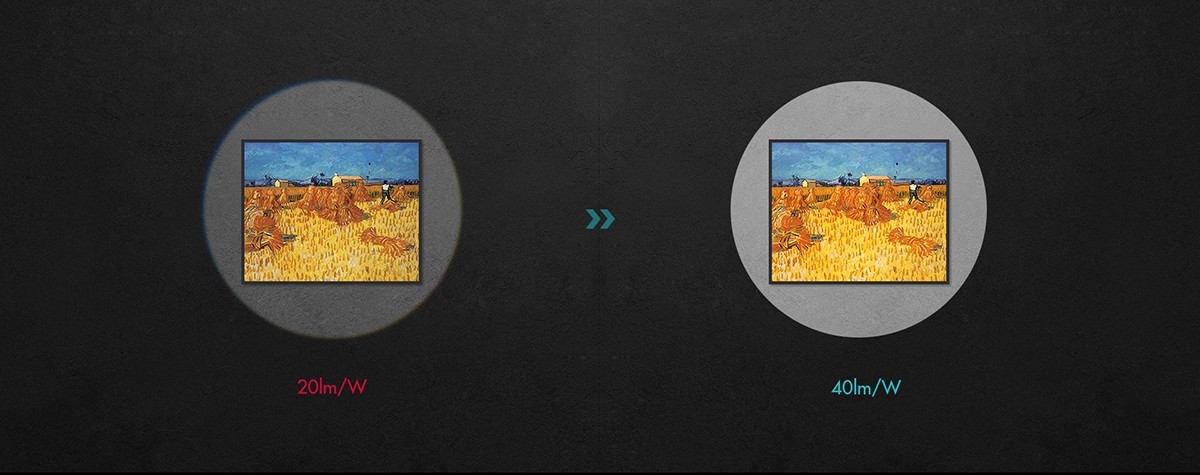
      Efficiency. Framing projectors lose light through multiple lenses, blades, and filters. Early systems delivered around 20 lumens per watt, which limited their use in energy-conscious projects. The current platform achieves 40 lm/W through optical system optimization, without compromising beam control. Designers who previously could not specify framing projectors due to energy code requirements now can.

Shaping Light with Precision: The Evolution of Framing Projector Technology


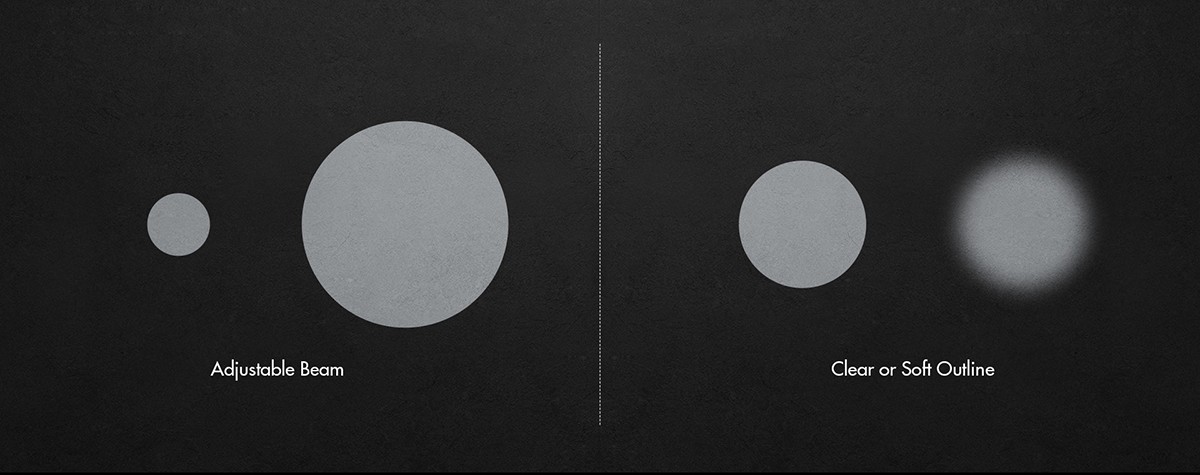
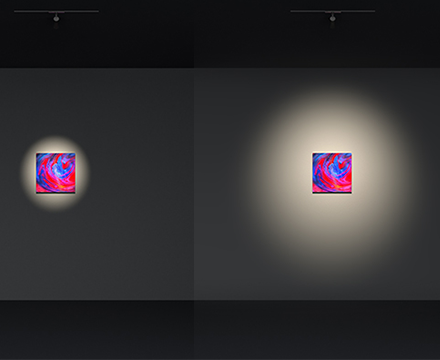
      Beam angle flexibility. One platform, three configurations to cover different object sizes:

    Configuration

    Beam angle

    Best for

    Fixed wide

    55°

    Large wall surfaces, ambient fills

    Zoom

    13° to 36°

    Flexible scene coverage

    Edge control

    Adjustable

    Soft or hard edge transition


      Fewer fixture types to specify, more design freedom on site.

      Shaping Light with Precision: The Evolution of Framing Projector Technology


      Designed for real projects


Shaping Light with Precision: The Evolution of Framing Projector Technology

IMAX: when 3 degrees is enough

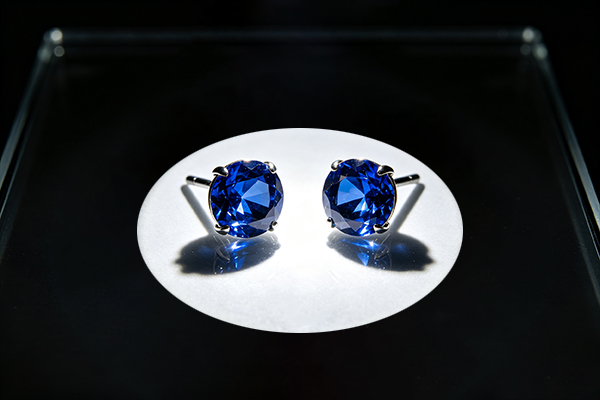
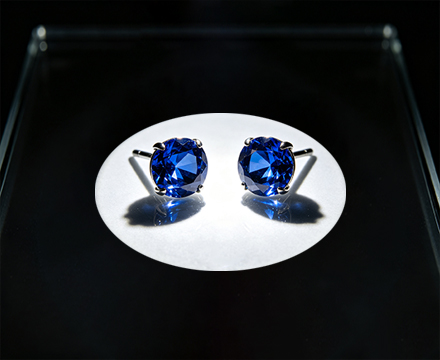
For extreme precision applications like illuminating a single piece of jewelry or a small artifact in a museum case, even a narrow beam from a standard framing projector is too wide. The IMAX projector uses an iris system that narrows the beam to 3 degrees. 

Three degrees is narrow enough to light a ring on a velvet pad without spilling onto the surrounding display. It is the kind of precision that luxury retail designers and museum conservators ask for when every photon matters.
Shaping Light with Precision: The Evolution of Framing Projector Technology

Control and mechanical precision

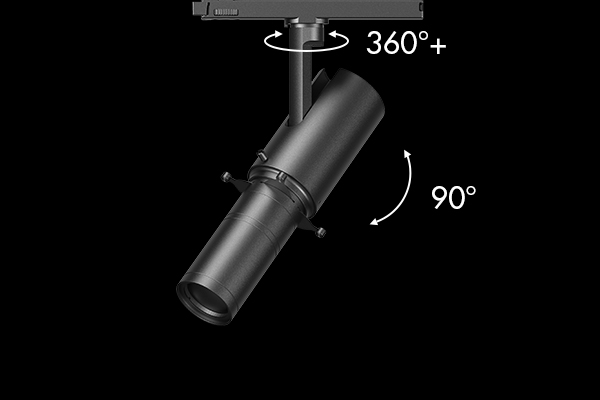
1% deep dimmingwith true continuous adjustment, not stepped Color temperaturetunable from 2700K to 6500K without gaps 360° horizontal rotationand 90° vertical tilt with precision locking

A projector that drifts half a degree over a few months will gradually misalign with the object it was aimed at, and nobody notices until the lighting looks wrong. The locking mechanism holds position steady over time.
Shaping Light with Precision: The Evolution of Framing Projector Technology

Light as a creative medium

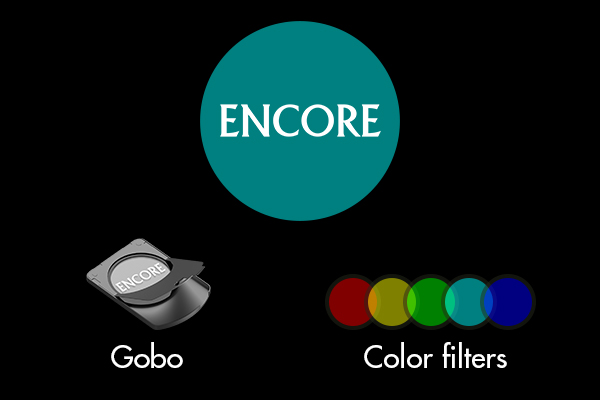
Color filters snap on without tools, letting designers layer color temperature and hue on top of the shaped beam. Gobo holders accept custom patterns, logos, or text, turning the projector into a tool for brand expression. A designer on site can swap a filter, test it, swap it again, and lock in the final configuration without reaching for a screwdriver. The fixture behaves more like a painter’s palette than a piece of hardware.
      Light as a creative discipline


      From TLM to VEGA, each iteration stripped away a layer of visual noise. Edge chromatic dispersion, gone. Illumination non-uniformity, gone. Beam artifacts inside the cut shape, gone. What remains is light refined into something closer to a building material than a byproduct of a fixture. Something a designer can shape and position with the same precision a sculptor brings to stone. 

      Every product in this line started with someone telling us what was not working. TLM because a curator needed cleaner edges on a gallery wall. IMAX because a jeweler needed to light a ring without lighting the case around it. The current generation because museum conservators needed color stability over thousands of hours. The throughline is not the product names. It is the principle: make the fixture disappear, and let the artwork speak for itself. 

      Looking ahead, Encore will continue deepening its work in high-precision optics, focused on the spaces where precision matters most: museums, galleries, and cultural institutions worldwide. The goal is to give curators and lighting designers a canvas of light they can control with confidence. A tool precise enough to shape drama and immersion in a space, quiet enough to vanish when the artwork speaks. When the fixture disappears and the object glows as if lit from within, the work is done. 

      We believe light has a soul. Everything we build starts from there.

Shaping Light with Precision: The Evolution of Framing Projector Technology

Previous: None

Next: Zoom Technology in Architectural Lighting: Sculpting Evolving Spaces with Flawless Beams

Latest News